What Is a Rotary Microtome?
A rotary microtome is a precision instrument widely used in pathology and histology laboratories to prepare thin paraffin-embedded tissue sections for microscopic analysis. Paraffin sectioning remains the most common technique in histology, essential for observing normal cell structure, diagnosing pathological changes, conducting forensic investigations, and supporting advanced research fields such as immunohistochemistry and genome sequencing.
Because microtomes ensure accuracy, reproducibility, and consistent section thickness, the rotary microtome has become the mainstream tool in modern diagnostic histopathology.

Who Uses a Rotary Microtome?
Rotary microtomes are indispensable across multiple sectors:
Clinical laboratories: pathology, dermatology, oncology, ophthalmology, OB-GYN, cardiology
Third-party pathology & diagnostic centers
Research institutions and universities
Morphology teaching laboratories
Pharmaceutical & CRO facilities
Single-cell genome sequencing companie
Main Applications of Rotary Microtomes
Rotary microtomes are used for:
Observing the structure of normal and pathological tissues
Studying cellular morphology during disease progression
Preparing sections for immunofluorescence & immunohistochemistry
Preparing samples for genome sequencing and molecular studies
types of microtome : Advantages & Limitations
1. Rotary Microtome
Features:
Equipped with a single knife holder
Holds one knife at a time for trimming and sectioning
Advantages:
Enables serial cuts
Ideal for small biopsies, including fine needle puncture specimens
Disadvantages:
No major drawbacks—it's the most versatile tool for routine pathology
2. Slide Microtome
Features:
Knife and specimen move together during trimming
Supports installation of two knives
Advantages:
Efficient for large tissue blocks
Saves knife usage
Excellent for multi-layer tissue observation
Disadvantages:
Cuts one section at a time
Requires static removal tools, increasing cost
Inefficient for small biopsies
Slow for routine pathology
3. Vibratome
Features:
Cuts fresh, unfixed, and non-frozen tissues
Section thickness typically 20–100 μm
Advantages:
Preserves lipid-soluble substances and antigens
Best for neurological system studies and immune electron microscopy
Market Trend
Due to varying diagnostic needs, a single-function microtome is insufficient. Today, rotary microtomes dominate the market thanks to their precision, versatility, and compatibility with modern lab workflows.
Three Types of Rotary Microtomes
| Type | Features | Description |
|---|---|---|
| Manual Rotary Microtome | Handwheel mechanism | Low cost; motor gear wear may reduce long-term precision |
| Semi-Automatic Rotary Microtome | Injection knob or control panel; motorized system | High precision, extended lifespan, ideal for clinical labs |
| Automated Rotary Microtome | Fully automated slicing modes | Same precision as semi-automatic; ideal for research labs and new technicians |
Rotary Microtome Parts and Their Functions
1. Injection System
A highly precise mechanism composed of:
Cross-roller bearings
Spindle
Stepper motor
Link block
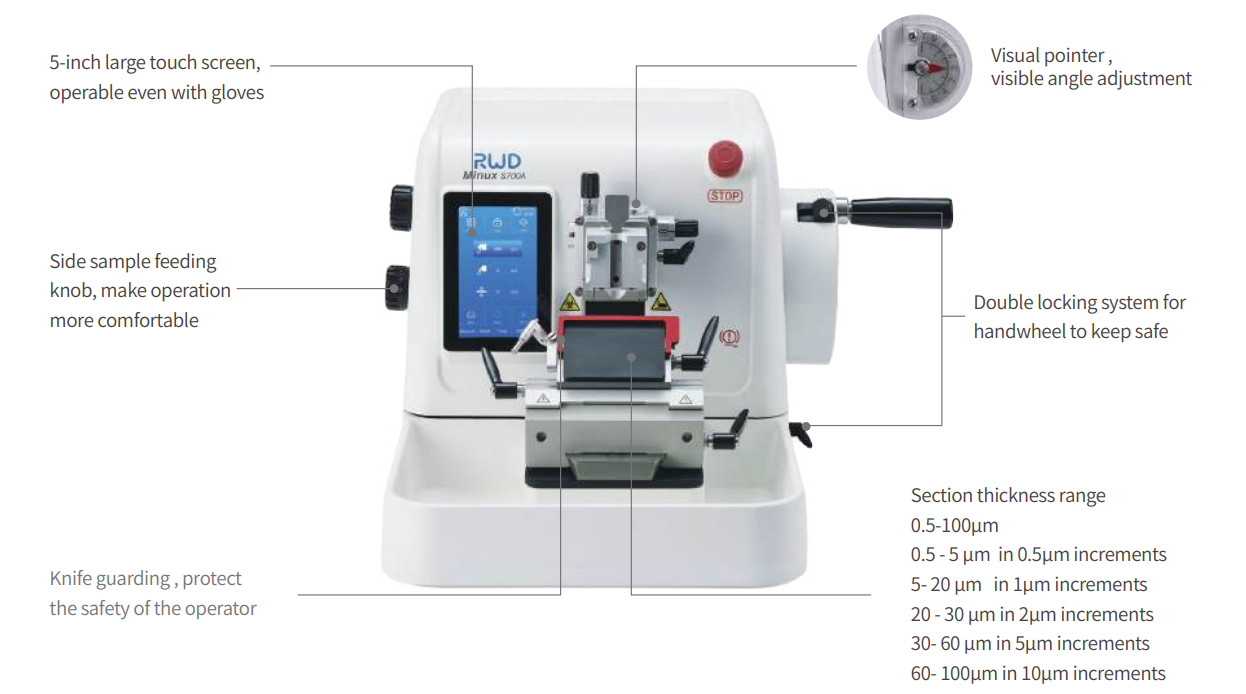
Together, these components ensure accurate section thickness down to 0.5 μm, guaranteeing high-quality tissue ribbons.
2. Fixation System
A visual calibration pointer marks the specimen head
Enables real-time alignment
Ideal for thicker blocks or unusual cutting angles
3. Sectioning System
Encoder receives automated cutting signals
Digital braking stabilizes the handwheel
Offers four cutting modes: single, continuous, interval, multi
Cutting window improves work efficiency
4. Safety System
Double handwheel lock
Retraction system protects both the user and the blade